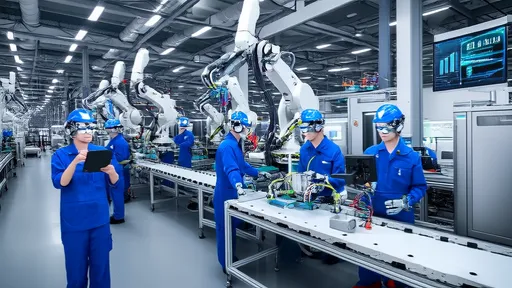
Anhui Province has emerged as a powerhouse in China's robotics sector, with its intelligent robotics industry recently surpassing a staggering 60 billion yuan in output value. This milestone not only underscores the region's growing influence in high-tech manufacturing but also signals a broader shift in the global robotics landscape. The province's strategic focus on innovation, coupled with robust government support and academic collaboration, has cultivated an ecosystem where domestic companies thrive and compete on the world stage.
What makes this achievement particularly noteworthy is the remarkably high localization rate of over 90%. This figure demonstrates how Chinese manufacturers have successfully developed and integrated core components and technologies that were once dominated by foreign suppliers. From precision reducers and servo motors to control systems and machine vision software, Anhui's robotics enterprises have made significant strides in mastering the entire production chain.
The rapid development didn't happen overnight. Anhui's journey in robotics began over a decade ago with targeted investments in research and development. The provincial government established specialized industrial parks in Hefei, Wuhu, and Ma'anshan, creating clusters that facilitate collaboration between universities, research institutions, and private enterprises. These innovation hubs have become breeding grounds for cutting-edge technologies and talent development.
Several homegrown companies have risen to prominence during this expansion. Estun Automation, based in Nanjing but with significant operations in Anhui, has become one of China's leading industrial robot manufacturers. Another success story is Anhui Effort Intelligent Equipment, which has made remarkable progress in developing delta robots and SCARA robots for packaging and assembly applications. These companies have not only captured domestic market share but have begun exporting their technologies internationally.
The educational infrastructure in Anhui has played a crucial role in this success. Universities such as the University of Science and Technology of China and Hefei University of Technology have established strong robotics engineering programs that feed directly into the local industry. These institutions collaborate closely with enterprises on research projects, ensuring that academic advancements quickly translate into commercial applications.
Government policies have been instrumental in nurturing the industry's growth. Anhui's authorities implemented a comprehensive support system that includes tax incentives, research grants, and streamlined regulatory processes for high-tech enterprises. The province also established special funds to help robotics companies overcome technical barriers and accelerate industrialization of their innovations.
Market dynamics have equally contributed to this success story. China's manufacturing sector's ongoing transformation toward automation has created enormous demand for industrial robots. As factories across the country seek to improve efficiency and quality while reducing labor costs, Anhui's robotics manufacturers have found ready customers in industries ranging from automotive and electronics to logistics and food processing.
The high localization rate brings significant advantages beyond economic metrics. It enhances supply chain security, reduces dependence on foreign technology, and allows for better customization to meet specific domestic needs. Chinese manufacturers can now respond more quickly to customer requirements and provide more cost-effective solutions compared to international competitors.
Despite these achievements, challenges remain. The industry continues to face gaps in certain high-end components and software algorithms compared to global leaders. However, companies in Anhui are aggressively investing in these areas, with several breakthroughs expected in the coming years. The focus is particularly strong on artificial intelligence integration and developing robots capable of more complex tasks and human-robot collaboration.
The environmental impact of this industrial growth hasn't been overlooked. Anhui's robotics companies have embraced green manufacturing practices, optimizing energy consumption in their production processes and developing energy-efficient robots for their customers. This alignment with China's carbon neutrality goals demonstrates the industry's commitment to sustainable development.
Looking ahead, Anhui aims to not only maintain but accelerate its growth trajectory. The provincial government has outlined ambitious plans to develop next-generation robots incorporating 5G, edge computing, and advanced AI capabilities. These technologies will enable new applications in healthcare, elderly care, and disaster response, expanding the robotics market beyond traditional industrial applications.
International collaboration remains an important aspect of Anhui's strategy. While celebrating domestic achievements, the province continues to welcome foreign investment and technical cooperation. Several joint ventures between Chinese and international companies have been established, creating synergies that benefit all parties and contribute to global technological advancement.
The success of Anhui's intelligent robotics industry offers valuable lessons for other regions developing high-tech sectors. It demonstrates the effectiveness of combining government support, academic research, and market forces within a coordinated development strategy. As other provinces in China and countries worldwide seek to develop their own robotics capabilities, they may look to Anhui's model for inspiration.
With its solid foundation and clear vision for the future, Anhui is well-positioned to remain at the forefront of robotics innovation. The province's achievements to date represent not just economic success but technological sovereignty and industrial capability that will shape China's manufacturing landscape for decades to come. As the global robotics revolution continues to unfold, Anhui has firmly established itself as a force to be reckoned with.

By /Aug 27, 2025
By /Aug 27, 2025

By /Aug 27, 2025

By /Aug 27, 2025

By /Sep 12, 2025

By /Aug 27, 2025
By /Sep 12, 2025
By /Aug 27, 2025

By /Aug 27, 2025

By /Sep 12, 2025
By /Sep 12, 2025

By /Sep 12, 2025

By /Aug 27, 2025
By /Sep 12, 2025
By /Sep 12, 2025
By /Sep 12, 2025

By /Aug 27, 2025
By /Sep 12, 2025
By /Sep 12, 2025

By /Aug 27, 2025